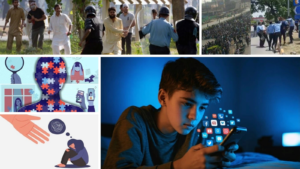

Neuroscience, developmental psychology, and the Islamic scholarly tradition agree on its existence, though they describe it differently. It is the period of early childhood, roughly from birth to age ten, in which the foundational architecture of identity, values, and worldview is laid down.
What happens in this window does not merely influence the child. It becomes the child, the lens through which every subsequent experience is filtered and interpreted.
What Neuroscience Tells Us
The human brain undergoes its most dramatic development in the first decade of life. Neural connections are formed, pruned, and consolidated at a rate that will never be matched again. The prefrontal cortex, responsible for moral reasoning, impulse control, and long-term thinking, is under intensive construction during this period.
Neuroscientist and developmental pediatrician Bruce Perry has demonstrated that early experiences, particularly those involving attachment, safety, and meaning, literally shape the brain’s architecture. A child raised with a stable, loving, values-rich environment develops neural pathways that support moral reasoning and emotional regulation throughout life.
The inverse is equally true. A child raised in an environment of instability, moral ambiguity, or identity confusion develops compensatory neural patterns that make stable identity formation in adolescence significantly harder.
What the Islamic Tradition Tells Us
The Prophet ﷺ understood the significance of early childhood long before neuroscience could measure it. His instruction to teach children the declaration of faith, ‘La ilaha illAllah’, as their first words was not merely a religious ritual. It was an act of identity installation at the deepest possible level.
The concept of Fitrah, the innate, God-given disposition of every human being, tells us that children are born oriented toward truth, beauty, and goodness. Education is not the installation of something foreign; it is the cultivation and protection of what is already present.
The Window and What Fills It
The critical reality is this: the identity window does not stay open indefinitely, and it does not stay empty. If a coherent, confident Islamic identity framework is not consciously built during these years, something else will fill the space.
Jean Piaget’s theory of cognitive development identifies the ‘preoperational’ and ‘concrete operational’ stages (roughly ages 2–11) as the period in which children construct their fundamental understanding of the world. During these stages, children are not passive recipients of information, they are active meaning-makers, building mental models that will govern their interpretation of everything that follows.
What this means practically: if a child’s mental model of the world is built primarily through Western media, secular schooling, and digital content, those frameworks become their default. Islamic values, introduced later in adolescence, will be experienced as external impositions on an already-formed worldview.
Building Identity Intentionally
Building Islamic identity in early childhood is not about restriction. It is about construction. It means filling the child’s world with stories of Islamic heroes, not sanitized myths, but real human beings who faced real challenges with real faith.
It means asking children questions that develop Islamic reasoning: Why did Allah create the world? What does justice feel like? How do we treat someone who has hurt us? These are not adult theological questions, they are developmentally appropriate conversations that build the neural and cognitive pathways of Islamic moral reasoning.
The window is open. The question is only: who is doing the building?